The Titrant Method
Most R&D is organized around building. This is organized around discovery and execution.
An idea enters as a loose concept and leaves as a decision with evidence attached. In between, every claim it rests on gets written down, ranked by what's at stake, and resolved cheapest-first — against a threshold set before anyone knows the answer.
One process, configured per domain and per client.
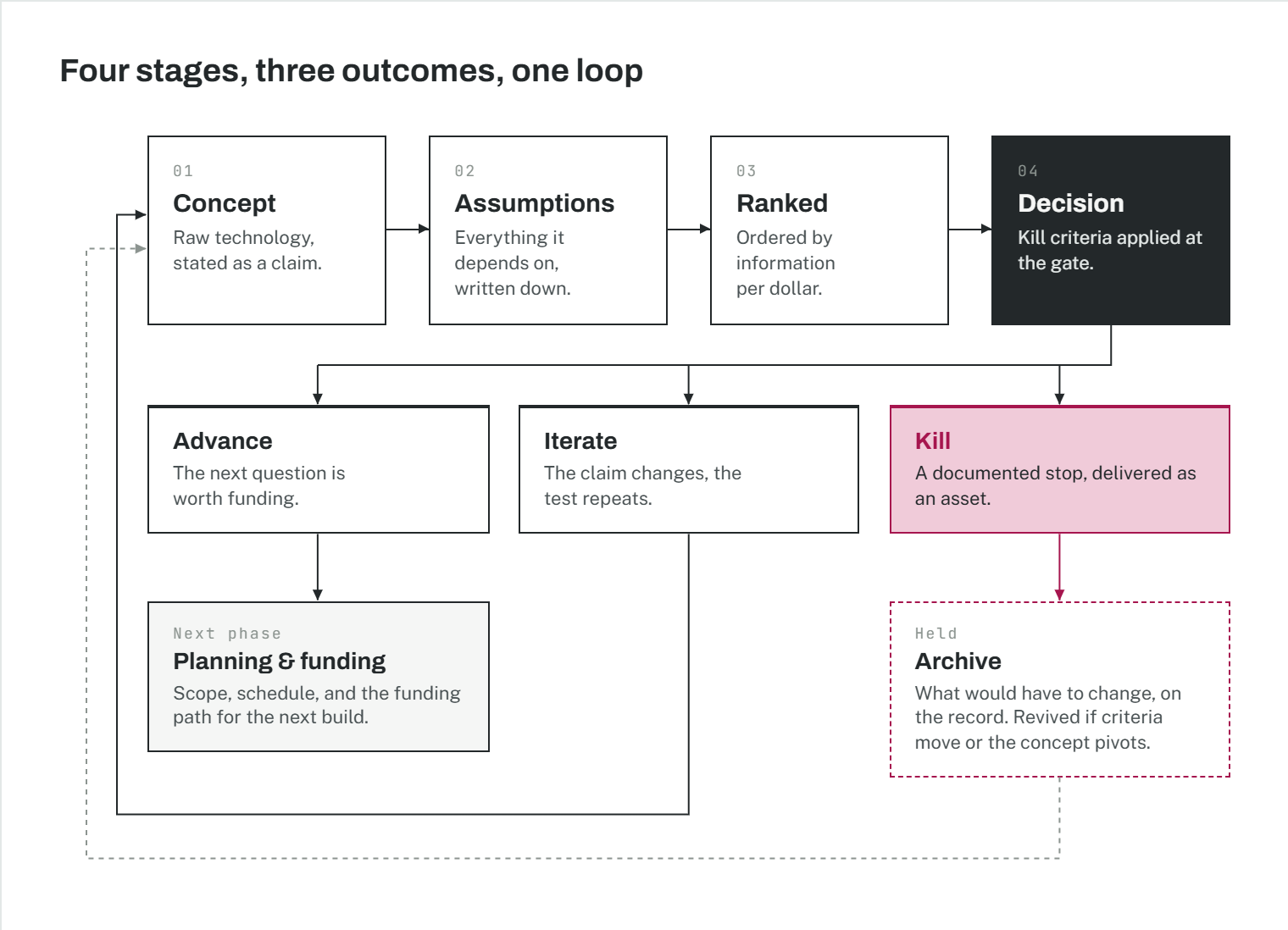
Figure 1 — The Pipeline
1 · Everything is an assumption
A concept isn't a thing to be evaluated. It's a stack of claims that have to be true, and most of them stay invisible until someone writes them down.
That's the first move, and it's harder than it sounds: the assumptions a team can articulate are rarely the ones carrying the project. We take the concept apart into individual claims — technical, market, regulatory, IP, manufacturing, economic, team — and every one gets a state, an owner, and a cost to resolve.
Everything after this operates on that record.
2 · Rank by exposure
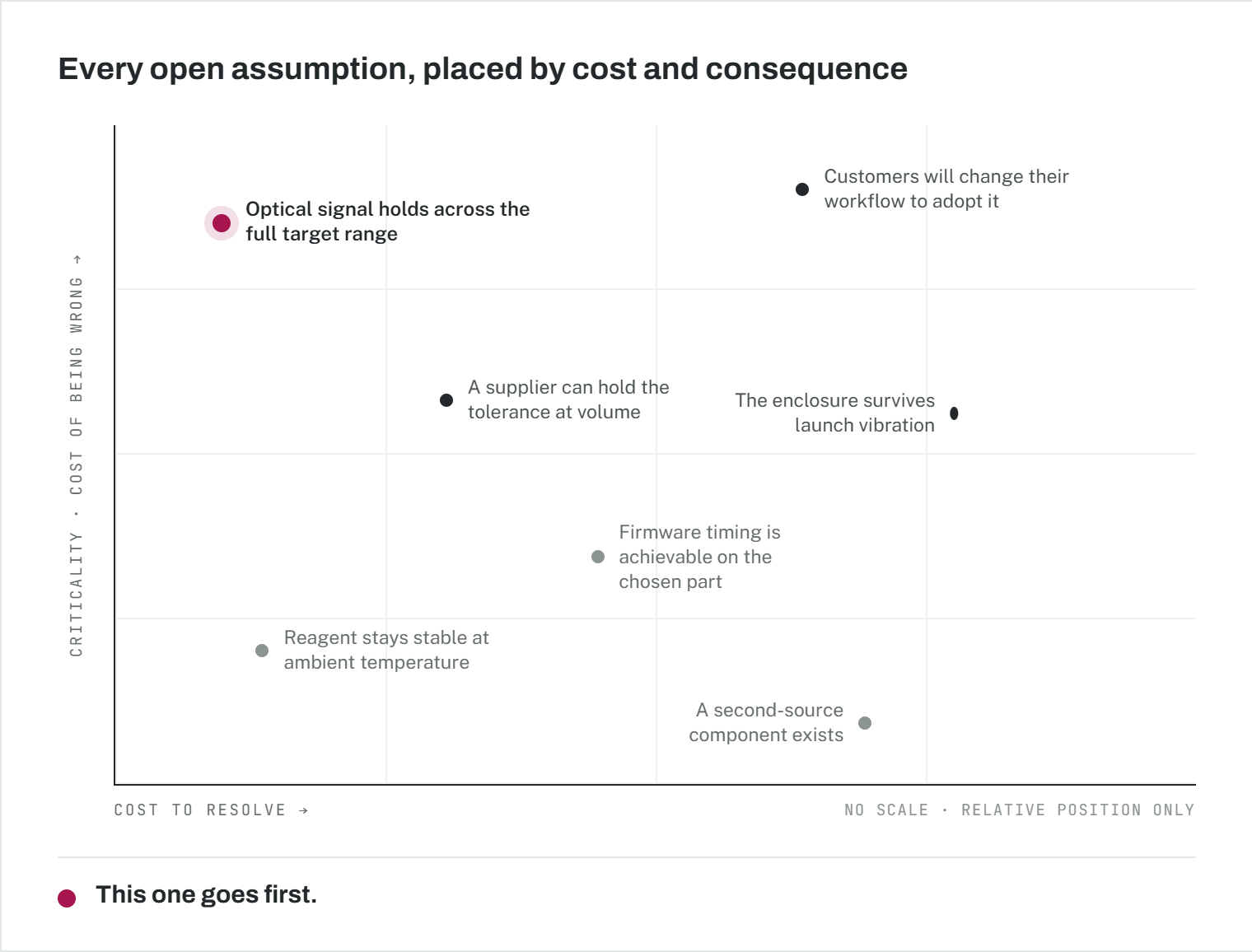
Every open assumption carries two things: how much is riding on it, and what it costs to find out. We call the pair exposure.
Ranked that way, a concept whose critical question is nearly free to answer outranks one with a bigger payoff sitting behind an expensive unknown. The first buys certainty cheaply. The second is exposure you're carrying for nothing.
The cheapest question that could kill the concept goes first. Especially when it's the uncomfortable one.
This sounds obvious. It's almost never what happens, because the tractable questions and the important questions are rarely the same question.
The weights are yours. Exposure is the frame, not a fixed formula. Prioritization criteria are set per domain and per client, which is what makes the ranking defensible inside your organization instead of imposed on it.
Figure 2 — The Exposure Plot
4 · Three outcomes, not two
Most stage gates have two settings: proceed, or proceed after rework. We use three.
Advance. The question is resolved. Move to the next one.
Iterate. The approach was wrong; the concept wasn't. Adjust and retest against a revised criterion, written down again.
Kill. The load-bearing assumption didn't hold.
A stop is a deliverable, not a failed engagement. What you bought was finding out, and finding out early is the entire product — the alternative isn't success, it's the same outcome later, after considerably more money. You get the negative result documented, so you learn from it instead of paying for it twice.
The stop is also what makes the other two worth anything. Because the process demonstrably kills concepts, an Advance carries a credibility that advocacy can't supply.
A kill isn't a filing. Conditions change — materials get cheaper, regulations move — and a documented dead end records what would have to change for the concept to be worth revisiting. We write them so they can be reopened.
And every decision is recorded against what was true when it was made, so nobody relitigates the evidence a year later.
3 · Write the kill criterion first
Before a test runs, we write down what result would end the project. In advance, in writing, agreed by everyone.
This sounds like a procedural detail. It is the single most important thing we do.
Without it, every result gets interpreted after the fact by people who want the project to continue — and it always can be. The data was noisy. The conditions weren't representative. One more iteration. That isn't dishonesty; it's how motivated reasoning works on competent, well-intentioned teams, and it's how organizations spend two years on something they had the evidence to stop in month three.
Deciding the threshold before you know the answer is the only reliable defense against it. It isn't optional in our process, and a concept doesn't reach a decision point without one.
5 · Evidence has standards
"Validated" is a word people use to mean anything from a working demonstrator to a conversation that went well.
We define it. For each class of question — is this physically possible, will it hold up in use, will anyone buy it, can it be made at cost, is it defensible — there's a written standard for what counts as weak, adequate, or strong evidence. The same standard applies across every engagement.
That consistency is what makes the output portable. When an assumption is marked resolved, it means the same thing in your portfolio as in anyone else's, and the same thing today as it did last year.
Those standards are Titrant's, and they're part of what you're buying access to. We apply them to your work; we don't publish them.
We also record what each class of question actually costs to resolve, across every project we run. That's what makes our estimates real rather than intuition — and it tells us where our own process is wrong. All of it runs on software we built for the purpose. The software isn't the product; the answers are.
6 · What survivors walk away with
A concept that comes through doesn't arrive at an investor or a program officer as an assertion. It arrives with its work shown: every assumption tested, what each test cost, what it returned, which questions are resolved and which are explicitly still open, what the stated threshold was and whether it was met.
Diligence stops being an interrogation and becomes a review of work already done. A technical reviewer who can see what you tested — including what you tested and didn't like the answer to — has reason to believe the parts you're claiming.
Concepts don't get funded because someone vouched for them. They get funded because the risk is legible.
And you never pay twice. Work at one stage carries into the next. Concepts come out of every engagement structured, so the next one starts where the last ended.
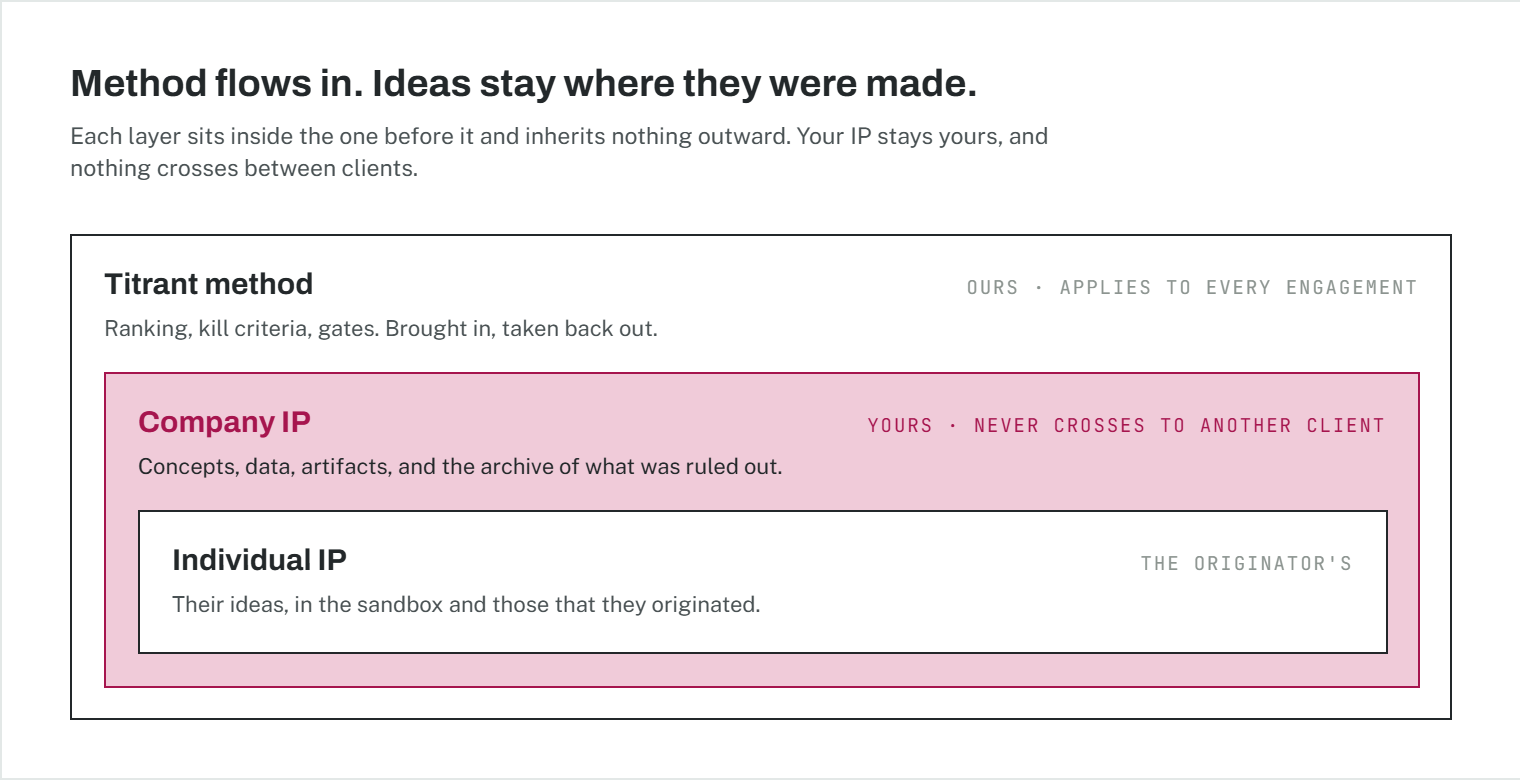
What's ours, what's yours
The Method is ours, always — the structure, the gate logic, the evidence standards.
A pipeline built for your organization is a configured instance of it, sitting on an industry layer that generalizes. Your configuration, your parameters, your portfolio, and your data are yours, in your own tenant.
The boundary is architected, not promised. Every query is scoped and fails closed. Projects default to private.